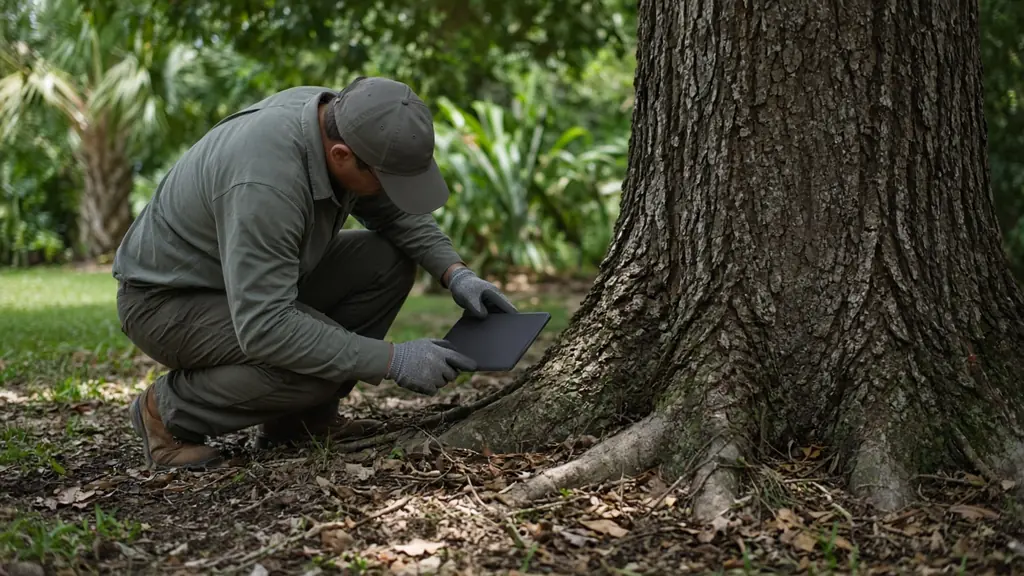
Why assess your trees before storm season
Most tree failures in hurricanes aren't random. Trees that come down usually had a defect that could have been spotted beforehand: decay at the base, a weak V-shaped union, a dead top, roots cut by a driveway or sewer repair years earlier, or a lean toward the house. A focused assessment before hurricane season starts on June 1 gives you time to deal with those trees at regular prices, on your schedule, instead of during a post-storm rush.
What we look at
A storm-readiness walkthrough focuses on trees large enough and close enough to hit something that matters: your house, your neighbor's house, the driveway, the pool enclosure or the street. For each, we look at:
- The root zone: mushrooms or conks at the base, soil cracks or heaving, cut or damaged roots, construction or grade changes near the trunk, and soggy ground.
- The trunk: cavities, cracks, seams, missing bark, carpenter ant activity, old wounds and lean.
- Unions: where trunks or large limbs meet, especially tight V-shaped unions with included bark, which are a common failure point in laurel and water oaks.
- The crown: dead branches, hangers left from past storms, heavy limbs extending over structures and overall vigor.
- Species and age: a 60-year-old laurel oak and a 60-year-old live oak are very different risks, even if they look similar at a glance.
- Targets: what the tree would hit if it or a large part of it failed.
What you get
You'll get a clear, plain-English recommendation for each tree that needs attention: leave it alone, prune it (and what kind), install cabling or bracing, monitor it, or remove it. Recommendations are prioritized so you can tackle the highest-risk trees first, with prices for any work you decide to do.
When a formal written risk assessment is needed, for example to document a dangerous tree under Florida's residential tree removal law (Section 163.045, F.S.), it should be prepared by an ISA Certified Arborist, ideally one holding the ISA Tree Risk Assessment Qualification (TRAQ). Let us know when you request the visit if you need that documentation, and we'll make sure the right person does it.
Common Pensacola-area findings
- Laurel and water oaks with internal decay. These fast-growing oaks dominate many older neighborhoods and often develop heart rot as they mature. Decay may be invisible from the outside; tapping, probing or a resistance drill can reveal it.
- Live oak limbs over roofs. Live oaks are among the most wind-resistant trees on the Gulf Coast, but long, heavy limbs extended over a house benefit from careful reduction.
- Dead or declining pines. Lightning strikes, beetles and drought stress kill pines that may look fine from the street until the needles turn. Dead pines should come down promptly.
- Root damage from construction. Driveways, additions, pools and sewer line replacements often sever roots on one side of a tree, making it more likely to uproot in saturated soil.
- Palms with dead fronds and seed stalks that become wind-borne debris.
Your hurricane tree checklist
Between assessments, these simple steps help:
- Walk your property every spring and after every major storm. Look up and look at the base of each large tree.
- Have dead branches and hangers removed before June.
- Don't pile cut branches at the curb when a storm is approaching; schedule debris work early.
- Keep heavy equipment, trenching and parking off root zones.
- Plant wind-resistant species like live oak, southern magnolia, bald cypress and sabal palm, and give them room.
- Keep our number, (850) 753-9465, handy for after the storm.
Book a walkthrough
Assessments are available throughout our service area. If the walkthrough turns up work, we'll explain options for pruning and removal, along with costs from our cost guide.
Frequently asked questions
When is the best time to have trees assessed?
Late winter through spring, before hurricane season begins June 1. That leaves time to schedule pruning or removal at normal prices. After any major storm, a second look is also smart.
Can cabling save a weak tree?
Sometimes. Cabling and bracing can support a tree with a weak union or heavy limb, but it isn't a fix for advanced decay or a dying tree. It also requires periodic inspection.
What is TRAQ?
The ISA Tree Risk Assessment Qualification is a credential for arborists trained in a standardized method of evaluating tree risk. It's the gold standard for formal written risk assessments.